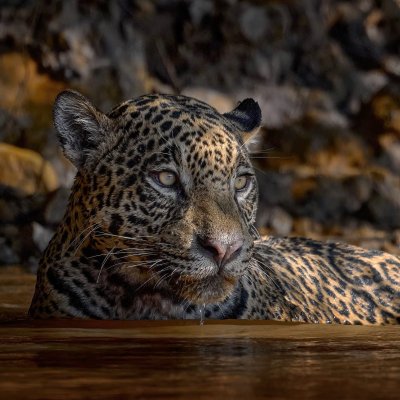
Jaguar Photography on the Rio Cuiabá

After encounters with many species of leopards, tigers, pumas, and lynxes, there was only one great cat left that I hadn't seen in the wild — the jaguar. Even though I had visited its habitats many times over the past twenty years. Always just tracks in the mud on the riverbank, claw marks on trees, or the remains of its kills. For years I've known exactly where to go to photograph a jaguar, but I was always put off by the conditions under which everyone meets this magnificent predator — I didn't want to compete with a dozen other boats just for the sake of a photo. But when the opportunity came up to organize a jaguar trip for Czech Photo Travel photographers, I took it. And in the end, with a certain amount of self-denial that I'm now slowly erasing from memory, I thoroughly enjoyed it.

The Guide

When I promised a photography trip to Brazil for the jaguar last summer, it was almost too late to arrange. The ideal date this year was mid-July to the end of August. Having some flexibility about exactly when to schedule the trip was our only chance.

It was close. I contacted a total of 16 (!) guides, lodges with boats, and agencies in the area with the ideal itinerary, and spent several weeks corresponding with those who responded. Most replied, but two-thirds were already fully booked.

Those who only offered their own fixed activity packages, without any flexibility for my needs, I crossed off right away. That left only two guides who accepted my wishes and itinerary and had at least one slot free in the ideal window. Their prices were the same, so in the end I decided based on references.

You can also go for the jaguar around the Rio Cuiabá in June or September, outside the peak of the season. For me that would actually be better in many ways (more on that below), but when I'm bringing clients who mainly want photos no matter what, I have to put my own desire for experiences and ideal shots second.

Our guide Alex was great. He knew a lot about jaguars, could immediately identify which individual we were looking at, and thanks to the local Jaguar Identification Project (more below) he even knew their names. Since I already knew all the commonly observed birds from my first visit to the Pantanal in 2011, I quickly confirmed that his knowledge was excellent there too.

Jaguár americký (Panthera onca) Jaguar, Rio Cuiaba, Mato Grosso, Brazílie (Saseka)
Ondřej Prosický | www.NaturePhoto.cz, Sony ILCE-1, Sony FE 300mm F2.8 GM OSS, f/4.5, @1/1250 s, ISO 800, pátek 24. července 2026 9:01:38, 2026-7-9603.jpg
Jaguár americký (Panthera onca) Jaguar, Rio Cuiaba, Mato Grosso, Brazílie (Medrosa)
Ondřej Prosický | www.NaturePhoto.cz, Sony ILCE-1, Sony FE 300mm F2.8 GM OSS + 2X Teleconverter, f/5.6, @1/320 s, ISO 200, středa 22. července 2026 6:56:27, 2026-7-6974.jpg

The Boat

After two photography stops along the Transpantaneira, we reached the river, where Alex and I negotiated what our ideal boat for photography should look like. We had plenty of days on the river, but there was no reason to sacrifice the first one when the matter could be settled the evening before our first outing. We were going to spend whole days on the river, so the boat was our top priority.

With rare exceptions, every jaguar sighting and photograph came from the boat on the river.

As soon as I brought up the topic, Alex started boasting about how great and fast our boat was, how powerful its engine was, and how we'd be first everywhere. And that was exactly what I didn't want.

When arranging the jaguar trip, I made a point of telling every guide I considered that I had no interest in racing to be first or closest to a spotted jaguar, and that I'd rather go look elsewhere instead. Just as in an open safari vehicle in Africa, I wanted calm, uncrowded conditions for photography — even if it meant fewer chances at the jaguar.

I'm grateful the clients felt the same way. In the end we had the fewest jaguar sightings of any trip that's gone from the Czech Republic in recent years, but I don't think anyone regretted it. The sessions where we had the jaguar to ourselves, even briefly, were worth it.

Space in the boat was also a priority for us, so everyone could have a camera backpack on the seat beside them and room to use a monopod or even a tripod for video. A big advantage of a large boat is also being able to move around for the ideal composition or for shooting from water level, without sending the boat to the bottom or knocking a fellow passenger into the river.

Boat stability matters.

If you have a fast boat, it's usually too narrow and unstable for photography. Almost all the boats on the Rio Cuiabá are like that. As soon as you raise a camera to your eye, the boat starts rocking, and if the whole group does it — or worse, everyone shifts to one side chasing a shot — you end up swimming in the river instead of taking a photo.

Our boat was wide; I could shoot video from a monopod or even a tripod and the boat barely moved. Another advantage was the low sides, which let the more skilled (and braver) photographers shoot directly from water level. Going by the motto "no wet lens hood, no water-level shot" — to get a jaguar's head in the water in frame, you have to get the opposite bank in too!

Jaguár americký (Panthera onca) Jaguar, Rio Cuiaba, Mato Grosso, Brazílie (Medrosa)
Ondřej Prosický | www.NaturePhoto.cz, Sony ILCE-1, Sony FE 300mm F2.8 GM OSS, f/2.8, @1/500 s, ISO 500, středa 22. července 2026 16:34:55, 2026-7-7838.jpg
Jaguár americký (Panthera onca) Jaguar, Rio Cuiaba, Mato Grosso, Brazílie (Aju)
Ondřej Prosický | www.NaturePhoto.cz, Sony ILCE-1M2, Sony FE 70-200mm F4 Macro G OSS II, f/8.0, @1/200 s, ISO 640, sobota 25. července 2026 6:47:29, 2026-7-1710.jpg

The River

The mighty flow of the Rio Cuiabá and its tributaries — the Rio Piquiri, Rio Três Irmãos, and Rio São Lourenço — form the heart of the northern Pantanal, and this is also the best place in the world to observe the jaguar.

During the local dry season, from July to the end of September, the water gradually recedes into the main river channels, exposing sandy beaches and concentrating an abundance of life — and jaguar prey — along the banks. Capybaras come there to drink, hundreds of caimans rest on the shallows once the sun climbs higher, and giant otters hunt in the deeper pools. And this is exactly where the jaguar finds its richest hunting ground.

The dense gallery forest lining the river gives it shade and perfect cover, from which it can watch prey unnoticed and strike within seconds — sometimes even from a branch overhanging the water. Unlike most cats, the jaguar is an excellent swimmer and doesn't avoid water. It often wades across the whole river or hunts directly in it.

It's precisely this combination of vast wetlands, abundant food, and natural cover that creates one of the highest densities of jaguars in the world along the Cuiabá (my estimate for the central area is up to 14 jaguars per 100 km², generally more like 6–12 per 100 km²).

Thanks to that, over five days we had 18 individual jaguar sightings from the boat! Well, really 17 — one was a mother with a cub crossing our path on our way to dinner.

Since the local project means all experienced guides know the jaguars by name, we saw at least ten different individuals in total. If my field notes are correct, each photo is labeled with the jaguar's name from the project.

Jaguár americký (Panthera onca) Jaguar, Rio Cuiaba, Mato Grosso, Brazílie (Apeiara)
Ondřej Prosický | www.NaturePhoto.cz, Sony ILCE-1, Sony FE 300mm F2.8 GM OSS + 2X Teleconverter, f/6.3, @1/1600 s, ISO 400, sobota 25. července 2026 9:00:52, 2026-7-0762.jpg
Jaguár americký (Panthera onca) Jaguar, Rio Cuiaba, Mato Grosso, Brazílie (Ibaca)
Ondřej Prosický | www.NaturePhoto.cz, Sony ILCE-1M2, Sony FE 70-200mm F4 Macro G OSS II, f/4.0, @1/1000 s, ISO 1000, středa 22. července 2026 16:15:26, 2026-7-1449.jpg

Names

Every jaguar in the area has its own unique story. Thanks to the Jaguar Identification Project (JIP), individual animals have been identified for more than twenty years by the unique pattern of rosettes on their coat.

What started as a simple photo catalog has gradually become one of the most detailed databases of wild big cats in the world. For the registered, named jaguars, scientists and photographers track not just movement and territory, but also family ties — siblings, mothers, cubs, partners, and the fates of successive generations as their habitat and conditions change.

Every year an updated digital guide in PDF form is published for the Rio Cuiabá area and its tributaries, adding newly discovered individuals, territorial changes, and new family relationships. It's fascinating to read who's related to whom, how old individual jaguars get, and to trace their sighting locations on a map.

You might learn, for instance, that the male jaguar Ousado had burned paws after the 2020 fires, allowed himself to be rescued, ended up at a rehabilitation center where he recovered quickly, and was released back into the wild with a tracking collar — where he's now doing wonderfully. I'll save the details for a separate story, but I can already say we got to check his paws while photographing him, and he's doing great!

Anyone can take part in the project — all you need is a photo of the jaguar's left or right side along with the location and date of the sighting. Every photograph can help confirm an animal's identity. You can add another chapter to the story of one of the best-studied jaguar populations in the world.

We very nearly got to name a jaguar ourselves. In the farthest spot we'd ever reached on the river, we found a hidden three-month-old cub that no one recognized. There's a rule here — whoever's boat finds an unnamed jaguar gets to name it. Unfortunately the cub was so well hidden that, while we did get a photo, it lacked the identifying marks needed for future recognition. But plenty of name suggestions came pouring out of our group anyway.

Naturally, my own view was that the name for the jaguar cub should somehow relate to our expedition's art director!

Proceeds from guide sales and donations support jaguar conservation, camera-trap research, education for local communities, and cooperation with ranchers. Thanks to that, Porto Jofre has become not just a world paradise for photographers, but also a model for successfully combining ecotourism, citizen science, and conservation.

Gone, thankfully, are the days — and not so long ago — when jaguar pelts were sold to poachers for as much as $2,000. Hunting jaguars was banned here in 1967, but poaching continued right up into the 1980s.

Jaguár americký (Panthera onca) Jaguar, Rio Cuiaba, Mato Grosso, Brazílie (Apeiara)
Ondřej Prosický | www.NaturePhoto.cz, Sony ILCE-1, Sony FE 300mm F2.8 GM OSS + 2X Teleconverter, f/6.3, @1/1000 s, ISO 400, sobota 25. července 2026 9:00:55, 2026-7-0792.jpg

Jaguár americký (Panthera onca) Jaguar, Rio Cuiaba, Mato Grosso, Brazílie (Medrosa)
Ondřej Prosický | www.NaturePhoto.cz, Sony ILCE-1, Sony FE 300mm F2.8 GM OSS, f/2.8, @1/1000 s, ISO 500, středa 22. července 2026 16:34:34, 2026-7-7799.jpg

Hats

Organizing photography from a boat, especially when you want to be out on the river all day, has its own quirks. After all, there were two guides and six clients — fortunately photographers I already knew well from previous trips, which made communication and mutual understanding easier.

Everyone agreed we'd head out onto the river as early as possible, even if it meant wolfing down breakfast at 5:30. Which is exactly what happened, and everyone got used to it during the trip. We gathered at the boat a few minutes earlier each day. Some decided it was more practical to pack breakfast to eat on the boat rather than sit down for a quick meal beforehand.

Even though we managed to head out first among the many dozens of boats in the area, often still in the dark when you could only guess the direction of sunrise, we never managed to hold that lead for more than the first kilometer. Choosing the slow, comfortable boat (detailed above) exacted its highest price right here.

From the harbor to the central area of the most frequent jaguar sightings is a 20–30 minute run at 35–40 km/h, during which one boat after another overtook us. But those boats then turned off toward "sure spots" within jaguar territory, letting us continue on alone upstream.

Similar to riding in a big open safari vehicle in Africa, we rotated seating pairs in the boat. Whoever was in the front row in the morning moved to the second row in the afternoon. Whoever was in the fourth, last row moved all the way to the front after noon. Every boat trip meant each pair moved back one row — so no one could say, "You always get the better spot up front, and you're in our shot besides!"

You have to remember that photographers aren't tourists — they need space. And naturally it happens that a sighting is sometimes comfortable for those on the left side of the boat, and sometimes for those on the right. Then it can easily happen that instead of a yawning jaguar, you find your colleague's head in your viewfinder. Or the photographer next to you shifts their composition and their lens, right at eye level, nearly knocks your head off.

The worst offenders are hats!

I understand that those of us from central Europe need to protect our pale faces from the sun, but for future trips in the area I'd recommend sunscreen instead. You never want a hat covering half of every photo!

Despite this minor friction, life together on the boat was genuinely idyllic for everyone.

Jaguár americký (Panthera onca) Jaguar, Rio Cuiaba, Mato Grosso, Brazílie (Apeiara)
Ondřej Prosický | www.NaturePhoto.cz, Sony ILCE-1, Sony FE 300mm F2.8 GM OSS + 2X Teleconverter, f/8.0, @1/2000 s, ISO 1250, sobota 25. července 2026 9:13:13, 2026-7-0831.jpg
Jaguár americký (Panthera onca) Jaguar, Rio Cuiaba, Mato Grosso, Brazílie (Aju)
Ondřej Prosický | www.NaturePhoto.cz, Sony ILCE-1M2, Sony FE 70-200mm F4 Macro G OSS II, f/9.0, @1/200 s, ISO 500, sobota 25. července 2026 6:51:13, 2026-7-1757.jpg

Next Time

Even though I suspected what I was getting into — or maybe precisely because of that — I ultimately survived the crowds of boats on the Rio Cuiabá without major damage to my mental health. Partly thanks to deliberately avoiding boat clusters where possible.

You can think what you like about those chaotic conditions, where dozens of boats can gather around a single animal, but tourism in some of the world's most precious natural corners also means that hunters with a twisted desire to shoot something to hang as a trophy in their living room aren't running loose in the wilderness. Perhaps it's partly thanks to us that these magnificent predators are doing so well along the Rio Cuiabá.

If you'd also like to see these beautiful animals in the northern Pantanal, get in touch. I might return to the same spot next year.

But whenever I eventually travel to Brazil on my own in the future, I know exactly where I'd rather go for the jaguar. I'll have a quarter of the sightings, maybe not even that — but for me, the thrill of remote wilderness will be far greater.

Related links
Articles on wildlife photography in Brazil
Articles on nature photography
Photography trips
Photography workshops

Jaguár americký (Panthera onca) Jaguar, Rio Cuiaba, Mato Grosso, Brazílie (Saseka)
Ondřej Prosický | www.NaturePhoto.cz, Sony ILCE-1, Sony FE 300mm F2.8 GM OSS, f/4.5, @1/1000 s, ISO 400, pátek 24. července 2026 9:04:59, 2026-7-9685.jpg
Jaguár americký (Panthera onca) Jaguar, Rio Cuiaba, Mato Grosso, Brazílie (Bororo)
Ondřej Prosický | www.NaturePhoto.cz, Sony ILCE-1, Sony FE 300mm F2.8 GM OSS + 2X Teleconverter, f/5.6, @1/5000 s, ISO 800, čtvrtek 23. července 2026 16:40:03, 2026-7-9147.jpg
Jaguár americký (Panthera onca) Jaguar, Rio Cuiaba, Mato Grosso, Brazílie (Bororo)
Ondřej Prosický | www.NaturePhoto.cz, Sony ILCE-1, Sony FE 300mm F2.8 GM OSS, f/3.2, @1/2500 s, ISO 400, pátek 24. července 2026 8:13:56, 2026-7-9487.jpg
Jaguár americký (Panthera onca) Jaguar, Rio Cuiaba, Mato Grosso, Brazílie (Aju)
Ondřej Prosický | www.NaturePhoto.cz, Sony ILCE-1M2, Sony FE 70-200mm F4 Macro G OSS II, f/4.5, @1/250 s, ISO 800, sobota 25. července 2026 6:37:26, 2026-7-1589.jpg
Jaguár americký (Panthera onca) Jaguar, Rio Cuiaba, Mato Grosso, Brazílie (Saseka)
Ondřej Prosický | www.NaturePhoto.cz, Sony ILCE-1, Sony FE 300mm F2.8 GM OSS, f/2.8, @1/8000 s, ISO 250, pátek 24. července 2026 9:42:25, 2026-7-9736.jpg
Jaguár americký (Panthera onca) Jaguar, Rio Cuiaba, Mato Grosso, Brazílie (Medrosa)
Ondřej Prosický | www.NaturePhoto.cz, Sony ILCE-1, Sony FE 300mm F2.8 GM OSS, f/3.2, @1/400 s, ISO 500, středa 22. července 2026 16:38:22, 2026-7-7978.jpg
Jaguár americký (Panthera onca) Jaguar, Rio Cuiaba, Mato Grosso, Brazílie (Ousado)
Ondřej Prosický | www.NaturePhoto.cz, Sony ILCE-1, Sony FE 300mm F2.8 GM OSS + 2X Teleconverter, f/5.6, @1/640 s, ISO 1600, středa 22. července 2026 8:41:28, 2026-7-7293.jpg
Jaguár americký (Panthera onca) Jaguar, Rio Cuiaba, Mato Grosso, Brazílie (Saseka)
Ondřej Prosický | www.NaturePhoto.cz, Sony ILCE-1, Sony FE 300mm F2.8 GM OSS, f/3.2, @1/320 s, ISO 200, pátek 24. července 2026 9:44:32, 2026-7-9810.jpg
Naše jaguáří expedice, od přídi lodi Jirka, Roman, Martin, Ondra, Jana, HonzaT. HonzaL., Jarmila, Alex, kapitán u kormidla
řeka Rio Cuiba, Mato Grosso, Brazílie, 24. července 2026
Photographer
Ondřej Prosický
Ondřej Prosický

focuses on wildlife photography. He wants to capture the behavior of animals in their natural surroundings. Photo workshops and expeditions focusing on nature have been organizing since 2006, publishing in the media and having more than four dozen author exhibitions.

Among his greatest achievements is participation in the finals of the prestigious Wildlife Photographer of the Year photography competition. He has been a member of the Association of Professional Photographers of the Czech Republic since 2009. In May 2011, the European Federation of Professional Photographers awarded Ondřej Prosické the QEP (Qualified European Photographer) title in the Wildlife Photography category, and in the same year he received the FEP Landscape Golden Camera award in Brussels. The most recent awards are the nominations and main prizes of the Czech Press Photo, Czech Nature Photo and the Festival de l'Oiseau et de la Nature in France.

Vloženo
07. 08. 2026 , categories: nature, mammals
Share

Comments

(0 posts)
Add comment

Add comment