
A Southern sea lion hunting penguins

When Jirka came back after noon saying that he had seen a Southern sea lion hunting Gentoo penguins several times from the sandy beach at Sandy Bay, there was no need for much discussion. It is four kilometres there and four kilometres back, but the spectacle is well worth it. It is not exactly a long distance, but when you have already walked 10–12 kilometres since early morning with heavy camera equipment and a tripod, you start choosing your afternoon and evening opportunities and locations more carefully.

Without Dessert

The plan had only one flaw – dinner.
As guests of the locals, we were expected to show up for a pre-arranged multi-course meal. But that would significantly reduce our chances of getting the photographs we were after. If dinner dragged on, we would have barely an hour left for a possible sea lion attack on a penguin.

As I swallowed the last bite of the excellent rack of lamb, I was on edge. The sun was slowly sinking towards the horizon, the sky was clear, and the light was beginning to turn orange.

A dessert spoon still sat untouched on the laid table, but I simply couldn't wait any longer. With the words, “We’re not here for the dessert,” I apologised and rather impolitely left the table first.

Well, “left”… As soon as I disappeared from view behind Semaphore Hill, I occasionally broke into a jog through the grass, weaving between geese and tussocks of kelp. I could already see the beach where the sea lions were hunting – the remaining three kilometres were now in sight.

Lachtan plavý (Otaria flavescens) South American sea lion, Bleaker Island, Falklandské ostrovy
Ondřej Prosický | www.NaturePhoto.cz, Sony ILCE-1, Sony FE 300mm F2.8 GM OSS + 2X Teleconverter, 600.00 mm, f/5.6, @1/400 s, ISO 400, úterý 17. února 2026 18:40:18, 2026-2-5638.jpg
Lachtan plavý (Otaria flavescens) South American sea lion, Bleaker Island, Falklandské ostrovy
Ondřej Prosický | www.NaturePhoto.cz, Sony ILCE-1, Sony FE 300mm F2.8 GM OSS, 300.00 mm, f/2.8, @1/1000 s, ISO 100, úterý 17. února 2026 19:18:48, 2026-2-6280.jpg

Hungry Sea Lion

It took me exactly 26 minutes to reach the beach.

Even from a distance, I could see through my binoculars a commotion of giant petrels in the waves, fighting over some scraps of food. Giant petrels are fantastic on the Falkland Islands – they reliably lead you to carcasses. Just like kelp gulls or striated caracaras. Given what Jirka had experienced that morning, it was immediately clear to me that they were finishing off the remains of a penguin.

As I got closer, I no longer felt like walking. A sea lion was circling nearby, and it was obvious that it intended to continue feeding. I knew I would be following it along the beach until it eventually charged into the sand after another penguin.

Staying with it, anticipating its moves, guessing which penguin it would go for, watching escape routes, obstacles, the light, the surroundings… This is exactly what I love about photographing wild animals!

Tučňák oslí (Pygoscelis papua) Gentoo penguin, Bleaker Island, Falklandské ostrovy
Ondřej Prosický | www.NaturePhoto.cz, Sony ILCE-1, Sony FE 300mm F2.8 GM OSS, 300.00 mm, f/2.8, @1/1600 s, ISO 100, úterý 17. února 2026 19:17:31, 2026-2-6166.jpg
Lachtan plavý (Otaria flavescens) South American sea lion, Bleaker Island, Falklandské ostrovy
Ondřej Prosický | www.NaturePhoto.cz, Sony ILCE-1, Sony FE 300mm F2.8 GM OSS, 300.00 mm, f/2.8, @1/2500 s, ISO 100, úterý 17. února 2026 19:19:17, 2026-2-6298.jpg

The Flying Penguin

It took less than five minutes. In the round, dark eyes of the sea lion, its head rigidly protruding from the waves, it was absolutely clear which penguin it had chosen. I dropped down onto the beach, chin almost in the sand, to get a better shooting angle. As soon as the first wave of sand landed in my ears and eyes – courtesy of the infamous Falkland wind – I knew I had got it wrong. There was no way I could fit both protagonists into the frame with my 300mm lens.

But by then, a penguin was already “flying” past me just above the ground. If your biology teacher told you that penguins are flightless birds, naturalists had simply never seen one with a sea lion on its tail. Sand was flying around the penguin as it flapped its tiny, narrow wings perhaps five times a second and raced straight towards me.

I had no time to dodge while lying on the ground. Nor did it even cross my mind to save its life – I had already settled that dilemma with myself many times while photographing wildlife.

I didn’t move an inch. I only rolled out of the way just before the hungry sea lion reached me. It is a large animal, weighing up to 350 kg. I was slightly worried that it might decide to deal with me as a competitor for its food.

Lachtan plavý (Otaria flavescens) South American sea lion, Bleaker Island, Falklandské ostrovy
Ondřej Prosický | www.NaturePhoto.cz, Sony ILCE-1, Sony FE 300mm F2.8 GM OSS, 300.00 mm, f/2.8, @1/4000 s, ISO 250, neděle 22. února 2026 8:46:46, 2026-2-8149.jpg
Lachtan plavý (Otaria flavescens) South American sea lion, Bleaker Island, Falklandské ostrovy
Ondřej Prosický | www.NaturePhoto.cz, Sony ILCE-1, Sony FE 300mm F2.8 GM OSS, 300.00 mm, f/2.8, @1/12800 s, ISO 100, úterý 17. února 2026 19:18:12, 2026-2-6201.jpg

Up the Hill

I was surprised by how fast these decidedly marine animals – both the sea lion and the penguin – can move on land when they have something important at stake (food or survival). They chased each other across the sand for quite a while. Their speed is comparable; it is more a question of who gets tired first, runs into an obstacle, or makes a mistake.

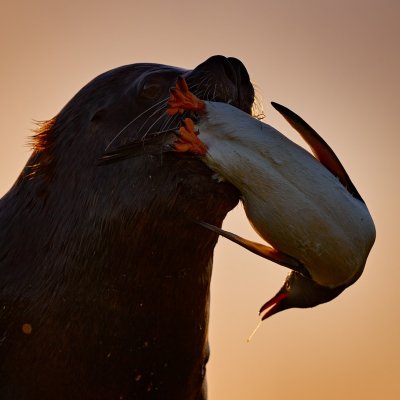
Which is exactly what happened. They had to head up the slope, and that proved fatal for the Gentoo penguin. It slowed down – snap! The sea lion posed beautifully for a backlit photo with its catch (thanks!) and then it was off. Taking the shortest route, it carried the penguin back towards the sea. All our observations were the same – once it catches a penguin on land, it immediately carries it into the waves. Into deeper water, where it thrashes it violently (the so-called “thrashing”), almost stripping it of its skin or tearing it apart…

As soon as the sea lion began feeding in the waves, a flock of giant petrels immediately joined it, occasionally managing to steal a morsel.

By then, I could see my friends approaching in the distance, dessert safely in their stomachs. They were gradually picking up speed as they realised from afar what spectacle had just unfolded before them.

That evening, the sea lion gave us another chance for more photographs – it was hungry and clearly in the mood for hunting – and two more penguins paid the price.

Lachtan plavý (Otaria flavescens) South American sea lion, Bleaker Island, Falklandské ostrovy
Ondřej Prosický | www.NaturePhoto.cz, Sony ILCE-1, Sony FE 300mm F2.8 GM OSS, 300.00 mm, f/2.8, @1/400 s, ISO 100, úterý 17. února 2026 19:19:03, 2026-2-6281.jpg
Lachtan plavý (Otaria flavescens) South American sea lion, Bleaker Island, Falklandské ostrovy
Ondřej Prosický | www.NaturePhoto.cz, Sony ILCE-1, Sony FE 300mm F2.8 GM OSS, 300.00 mm, f/3.2, @1/20000 s, ISO 1000, úterý 17. února 2026 18:50:26, 2026-2-5881.jpg

The Beach Tourist

The undisputed hero of our sea lion photography was Mecan. He spent many hours on the beach with them. And it is not simply a matter of sitting down in the sand and waiting. The sea lion constantly patrols the beach, back and forth, searching for penguins on the shore, watching them, thinking and choosing its target. And you have to keep moving with it.

You can do it without running, but that day at Volunteer Point, Mecan clocked more than 30,000 steps on his watch. No wonder – just look at how long the beach is on a map and try keeping up with a sea lion there!

Although I spent more time at the colony than on the beach, I understand Martin’s determination. At Volunteer Point, the sea lions hunt Magellanic penguins that are perhaps three times larger. Now that is a spectacular show. Unfortunately, most of the successful attacks here took place in the water – the sea lion caught the penguin in the waves close to the beach.

A few dozen minutes later, the sea washed the remains ashore. The sea lion had basically eaten only the “breast meat”; the rest was left for the scavengers – giant petrels, gulls, kelp gulls and striated caracaras.

Still, I know – I think Honza even has a photograph of it – that in roughly a quarter of the cases, the sea lion also caught a Magellanic penguin on the beach. I saw it only once, from a great distance, and enjoyed it through my binoculars, without the stress of trying to photograph it.

Tučňák oslí (Pygoscelis papua) Gentoo penguin, Bleaker Island, Falklandské ostrovy
Ondřej Prosický | www.NaturePhoto.cz, Sony ILCE-1M2, Sony FE 70-200mm F4 Macro G OSS II, 70.00 mm, f/5.6, @1/250 s, ISO 100, neděle 22. února 2026 10:58:02, 2026-2-4292.jpg
Lachtan plavý (Otaria flavescens) South American sea lion, Bleaker Island, Falklandské ostrovy
Ondřej Prosický | www.NaturePhoto.cz, Sony ILCE-1, Sony FE 300mm F2.8 GM OSS, 300.00 mm, f/2.8, @1/3200 s, ISO 100, úterý 17. února 2026 19:19:18, 2026-2-6331.jpg

Evening Hunt

Based on our observations in the Falkland Islands, sea lions are relatively successful when hunting penguins, and the literature makes it clear that this is learned individual behaviour – not every sea lion does it. Their usual prey consists mainly of fish, cephalopods and crustaceans.

The best time was when the beaches had the highest number of penguins – in the morning, when they were heading out to sea, and especially in the evening, when they were returning exhausted after a full day of hunting.

The Southern sea lion (Otaria flavescens), known in English as the “South American sea lion”, has somewhat inconsistent Czech nomenclature. To optimise search engine visibility, you will therefore find both Czech names, lachtan hřivnatý and lachtan plavý, on my website. Both are, of course, correct.

Související odkazy
Falklandské ostrovy, znovu za tučňáky
Články o fotografování přírody
Nabídka fotografických cest
Nabídka fotografických workshopů

Lachtan plavý (Otaria flavescens) South American sea lion, Bleaker Island, Falklandské ostrovy
Ondřej Prosický | www.NaturePhoto.cz, Sony ILCE-1, Sony FE 300mm F2.8 GM OSS, 300.00 mm, f/3.5, @1/12800 s, ISO 1000, úterý 17. února 2026 18:55:18, 2026-2-6053.jpg
Lachtan plavý (Otaria flavescens) South American sea lion, Bleaker Island, Falklandské ostrovy
Ondřej Prosický | www.NaturePhoto.cz, Sony ILCE-1, Sony FE 300mm F2.8 GM OSS, 300.00 mm, f/2.8, @1/6400 s, ISO 100, úterý 17. února 2026 19:18:16, 2026-2-6201.jpg
Tučňák oslí (Pygoscelis papua) Gentoo penguin, Bleaker Island, Falklandské ostrovy
Ondřej Prosický | www.NaturePhoto.cz, Sony ILCE-1, Sony FE 300mm F2.8 GM OSS, 300.00 mm, f/4, @1/4000 s, ISO 250, pátek 20. února 2026 18:34:21, 2026-2-7844.jpg
Lachtan plavý (Otaria flavescens) South American sea lion, Bleaker Island, Falklandské ostrovy
Ondřej Prosický | www.NaturePhoto.cz, Sony ILCE-1, Sony FE 300mm F2.8 GM OSS, 300.00 mm, f/3.2, @1/25600 s, ISO 1000, úterý 17. února 2026 18:50:47, 2026-2-6028.jpg
Lachtan plavý (Otaria flavescens) South American sea lion, Sea Lion Island, Falklandské ostrovy
Ondřej Prosický | www.NaturePhoto.cz, Sony ILCE-1, Sony FE 300mm F2.8 GM OSS, 300.00 mm, f/4,5, @1/1600 s, ISO 250, středa 25. února 2026 19.22:47, 2026-2-6028.jpg
Lachtan plavý (Otaria flavescens) South American sea lion, Bleaker Island, Falklandské ostrovy
Ondřej Prosický | www.NaturePhoto.cz, Sony ILCE-1, Sony FE 300mm F2.8 GM OSS, 300.00 mm, f/3.2, @1/20000 s, ISO 1000, úterý 17. února 2026 18:50:27, 2026-2-5881.jpg
Lachtan plavý (Otaria flavescens) South American sea lion, Bleaker Island, Falklandské ostrovy
Ondřej Prosický | www.NaturePhoto.cz, Sony ILCE-1, Sony FE 300mm F2.8 GM OSS, 300.00 mm, f/2.8, @1/32000 s, ISO 100, úterý 17. února 2026 19:18:25, 2026-2-6268.jpg
Photographer
Ondřej Prosický
Ondřej Prosický

focuses on wildlife photography. He wants to capture the behavior of animals in their natural surroundings. Photo workshops and expeditions focusing on nature have been organizing since 2006, publishing in the media and having more than four dozen author exhibitions.

Among his greatest achievements is participation in the finals of the prestigious Wildlife Photographer of the Year photography competition. He has been a member of the Association of Professional Photographers of the Czech Republic since 2009. In May 2011, the European Federation of Professional Photographers awarded Ondřej Prosické the QEP (Qualified European Photographer) title in the Wildlife Photography category, and in the same year he received the FEP Landscape Golden Camera award in Brussels. The most recent awards are the nominations and main prizes of the Czech Press Photo, Czech Nature Photo and the Festival de l'Oiseau et de la Nature in France.

Vloženo
26. 03. 2026 , categories: nature, mammals
Share

Comments

(0 posts)
Add comment

Add comment