Another Chapter in the Adventure
Take photographers into the wild and hope that they will at least encounter the animals at one of the three locations. When I last went looking for Alpine ibex in Switzerland in 2021, we had four promising locations in stunning landscapes, and everything worked out perfectly at all of them – helped by stable weather.
But then again, we wouldn’t be in the Alps. The weather there is unpredictable every time. A little wind picks up, a cloud rolls in, rain or snow starts falling, and your chances are gone.
This year, it was a very close call.
fog
It was actually a good thing that we had set off on our journey through Europe a day earlier, mainly to make the driving more relaxed. This gave us almost a full extra day on the ridge in the Bernese Alps. As it turned out, it was our only chance to see the Alpine ibex at the first location without being trapped in impenetrable low cloud and rain.
The first afternoon and early evening were beautiful. Stunning views, blue skies, scattered clouds and sunshine. But as evening approached, the weather began to close in from the northwest. I wasn’t surprised. As I have already mentioned somewhere here, one disadvantage of modern weather apps is that when they forecast several days of awful weather, they can often get it right several days in advance. Especially when forecasts from different sources agree. Neither the global Windy nor the local MeteoSwiss were promising anything good.
I knew the ridge well, having visited it several times. I knew that it was mainly home to females with last year’s young, and that before they give birth to this year’s kids at the beginning of July, they are relatively easy to find. There were perhaps twenty of them in two groups, and the photographers were surprised from the very first minutes by how tolerant they were. By approaching slowly, they could photograph both portraits and wide-angle shots showing the animals in their beautiful surroundings.
I kept encouraging them to make the most of every opportunity while the weather was still reasonably good.
By evening, the sky had clouded over, the rain started, and low cloud descended. The following day, the ibex were barely visible. But so what? Everyone has photographs of Alpine ibex in sunshine. We would add a little mystery to our images of these barely visible, shaggy-horned animals.
Our accommodation at the upper cable-car station, at an altitude of around 2,000 metres, was comfortable, yet we still spent a lot of time outdoors despite the miserable weather. I simply kept an eye on the latest radar data and watched for moments when it was worth taking shelter from the heavier rain.
It had one major advantage: there were hardly any tourists around. As a result, the photographers got to photograph a Black Grouse and a Rock Ptarmigan for the first time in their lives.
When the ridge is quiet, the chances of encountering wildlife increase dramatically.
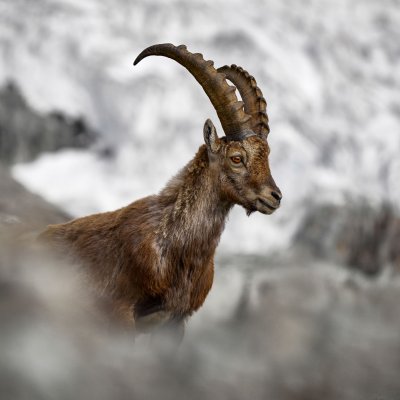
Kozorožec alpský (Capra ibex ibex) Alpine Ibex, Bernské Alpy, Švýcarsko
Ondřej Prosický | www.NaturePhoto.cz, Sony ILCE-1, Sony FE 70-200mm F4 Macro G OSS II, f/4.5, @1/200 s, ISO 250, úterý 9. června 2026 17:16:26, 2026-6-7946.jpg
Když přestalo sněžit, Bernské Alpy, Švýcarsko
Ondřej Prosický | www.NaturePhoto.cz, Sony ILCE-1, Sony FE 70-200mm F4 Macro G OSS II, f/8.0, @1/80 s, ISO 100, středa 10. června 2026 20:02:37, 2026-6-8083.jpg
snow
We drove about 80 kilometres northeast and took a cable car up to another ridge where Alpine ibex could be found. I remembered seeing males there with really impressive horns. But the weather was even worse.
If someone had told me before the trip that we would get ten centimetres of snow in June, that it would snow heavily all day, visibility would be down to almost nothing and temperatures would drop below freezing, I wouldn’t have believed them. But that is the Alps for you. You always have to be prepared for anything. Fortunately, we were well equipped for the bad weather.
Even so, I didn’t want to take any unnecessary risks or make the clients walk across snow-covered, frozen rock ledges. They were extremely slippery. Given the conditions, I suggested that I would go and look for the ibex on my own. If I found them, I would send a message and come back for the others.
With some of the more determined photographers, I walked east and west, then east and west again. Several times a day, with snow falling all around us. And nothing.
Logically. The ibex would have had to be crazy to stay up there when they could simply descend 200 metres and graze on beautiful, fresh green grass. Down below, it was summer, with flowers blooming and everything looking wonderfully peaceful.
But you know me. If there is even a ten-percent chance of getting a better photograph, it is worth trying. Everyone has photographs taken in hundred-percent conditions. They don’t bring anything new or interesting.
I wanted a photograph of Alpine ibex in the snow so badly. And I really wanted the clients to experience such a scene too. It would give them another season to add to their photographs.
I even set my alarm for 4:45 a.m. and climbed to the summit. What if I managed to get above the clouds? All I would have to do then was send a message to our WhatsApp group saying that it was worth getting up.
I reached the summit, met Josef there, and it was immediately obvious that we could go back to bed for another two hours. Not only were we still in the low cloud, but it was clear that another layer of clouds was hanging above us. And breakfast wasn’t served until eight…
We didn’t see a single large animal at the location, apart from a Ring Ouzel, and we only had a brief glimpse of the mountain panorama in the evening.
In the morning, after a short discussion with myself, I decided that there was no point continuing with visibility this poor. We took the first cable car down to the car and headed for the Valais Alps, where the conditions were supposed to be much better.
Kozorožec alpský (Capra ibex ibex) Alpine Ibex, Bernaké Alpy, Švýcarsko
Ondřej Prosický | www.NaturePhoto.cz, Sony ILCE-1, Sony FE 70-200mm F4 Macro G OSS II, f/4.5, @1/100 s, ISO 250, úterý 9. června 2026 17:18:28, 2026-6-7984.jpg
Kozorožec alpský (Capra ibex ibex) Alpine Ibex, Valiské Alpy, Švýcarsko
Ondřej Prosický | www.NaturePhoto.cz, Sony ILCE-1, Sony FE 70-200mm F4 Macro G OSS II, f/6.3, @1/1600 s, ISO 400, čtvrtek 11. června 2026 18:50:01, 2026-6-8437.jpg
sun
My almost pathological optimism came up with nothing better for the transfer than taking a risk and driving over the Grimsel Pass at 2,164 metres. Maybe we would get some spectacular views. The route was longer, but “maybe this white blanket will finally break.”
Awful. And then more awfulness.
Visibility was terrible, there was snow on the road, and we couldn’t see a thing. In our minivan on summer tyres, we crawled along at walking pace. But as soon as we crossed over to the other side of the ridge, we entered a completely different world. Distant views, blue skies and, after a few bends on the way down, instead of zero degrees, we suddenly had 22°C.
Jirka was photographing the red Swiss trains travelling through the mountain landscape beneath little clouds in the blue sky.
Idyllic. Smiles all around.
Well, almost.
I hadn’t found a single ibex for almost two days, and we had only one afternoon and our final morning left for photography.
Taking photographers out in search of wild animals comes with a certain responsibility. Clients don’t like to accept that you may simply get unlucky and fail to photograph the species they have been dreaming of. Even if you have plenty of experience, know almost everything there is to know about the animals and their behaviour, and have been photographing ibex at two dozen locations across Switzerland, Italy, Austria and France for twenty years, if you don’t get lucky, there simply won’t be any ibex photographs.
But I wasn’t giving up. I believed we would find them, and I continued promising the photographers some seriously impressive horned males.
We got lucky already in the car park. Where I had left the car on my previous visit, there were only a few other vehicles, and it was clear that the road around the lake continued further. The snow slides that had blocked the road last time had recently been cleared by an excavator, and cars were obviously driving as far as the next lake, closer to the glacier.
I waited for a campervan returning from the glacier and exchanged a few words with the driver.
This was going to work.
We would explore the slopes from the car and park higher up.
We spotted two young ibex, but I immediately suggested that we keep driving. After all, we wanted some proper males.
The car park. Hardly anyone around. Clear skies. We were directly beneath the glacier and its enormous moraine. The road ended here.
And no ibex anywhere.
We photographed the landscape. I remembered that we should take a group photo. Bob was photographing flowers, Pepa and Josef pulled beers out of their backpacks, and Jirka, as always, was wandering furthest away and taking photographs.
I found a sheltered spot in the sunshine, sat down comfortably and picked up my binoculars.
The last chance.
For almost half an hour, I scanned the surrounding rocky slopes. Nothing. Then I noticed a flash of pale fur moving along the edge of a grey glacial moraine about 500 metres away.
Ibex!
They had big horns. And there were plenty of them.
Only then did I realise that if I hadn’t had binoculars…
I immediately started shouting to the others, directing them towards the route to the ibex, and set off to find Bob.
What followed was an absolutely perfect afternoon of photography that lasted until evening. There were fourteen ibex. All young, but already seriously impressive males with large horns. They were in a beautiful location, with the glacier in the background and wonderfully soft, diffused light. They were practising mock fights and showed no sign whatsoever of wanting to run away, even though we were standing just a few metres away from them as a group.
There was only one problem: the glacial stream. To get a better angle and photographs of the ibex with the glacier behind them, we needed to reach the other side. Josef and Pepa managed it easily. I nearly ended up in the water while jumping across the wet boulders and once again finished with water inside my boots almost up to my knees. Someone else went around from a distance, while Bob simply took off his shoes and walked through the water. Some of the others wisely decided not to venture into the wild current at all.
But it was worth it.
We spent several hours with the active ibex in this beautiful corner of the Alps, without another tourist in sight, right up until sunset.
When we finally climbed into the car, exhausted, I felt an enormous sense of relief. The photographers looked happy.
If you are interested in photographing Alpine ibex in Switzerland, I have prepared the next trip in cooperation with Czech Photo Travel for 7–11 June 2027.
Related links
Wildlife photography articles
Alpine ibex photographs on Shutterstock
Photography trips
Photography workshops
Kozorožec alpský (Capra ibex ibex) Alpine Ibex, Bernské Alpy, Švýcarsko
Ondřej Prosický | www.NaturePhoto.cz, Sony ILCE-1, Sony FE 70-200mm F4 Macro G OSS II, f/4.5, @1/60 s, ISO 250, úterý 9. června 2026 17:14:53, 2026-6-7928.jpg
Když přestalo na chvilku sněžit, Bernské Alpy, Švýcarsko
Ondřej Prosický | www.NaturePhoto.cz, Sony ILCE-1, Sony FE 70-200mm F4 Macro G OSS II, f/9.0, @1/80 s, ISO 250, středa 10. června 2026 20:50:57, 2026-6-8167.jpg
Kozorožec alpský (Capra ibex ibex) Alpine Ibex, Valiské Alpy, Švýcarsko
Ondřej Prosický | www.NaturePhoto.cz, Sony ILCE-1, Sony FE 70-200mm F4 Macro G OSS II, f/4.5, @1/2000 s, ISO 400, čtvrtek 11. června 2026 18:40:57, 2026-6-8379.jpg
Kozorožec alpský (Capra ibex ibex) Alpine Ibex, Bernské Alpy, Švýcarsko
Ondřej Prosický | www.NaturePhoto.cz, Sony ILCE-1, Sony FE 70-200mm F4 Macro G OSS II, f/4.0, @1/1000 s, ISO 100, pondělí 8. června 2026 12:26:04, 2026-6-7754.jpg
Kozorožec alpský (Capra ibex ibex) Alpine Ibex, Bernaké Alpy, Švýcarsko
Ondřej Prosický | www.NaturePhoto.cz, Sony ILCE-1, Sony FE 70-200mm F4 Macro OSS II, f/4.0, @1/800 s, ISO 200, úterý 9. června 2026 11:55:20, 2026-6-7816.jpg
Kozorožec alpský (Capra ibex ibex) Alpine Ibex, Valiské Alpy, Švýcarsko
Ondřej Prosický | www.NaturePhoto.cz, Sony ILCE-1, Sony FE 70-200mm F4 Macro G OSS II, f/4.5, @1/2000 s, ISO 400, čtvrtek 11. června 2026 18:54:46, 2026-6-8488.jpg
Kozorožec alpský (Capra ibex ibex) Alpine Ibex, Bernské Alpy, Švýcarsko
Ondřej Prosický | www.NaturePhoto.cz, Sony ILCE-1, Sony Sony FE 24mm F1.4 GM (SEL24F14GM), f/1.4, @1/2500 s, ISO 250, úterý 9. června 2026 17:58:07, 2026-6-8052.jpg
Když přestalo na chvilku sněžit, Bernské Alpy, Švýcarsko
Ondřej Prosický | www.NaturePhoto.cz, Sony ILCE-1, Sony Sony FE 24mm F1.4 GM (SEL24F14GM), f/13, @1/10 s, ISO 100, středa 10. června 2026 20:21:25, 2026-6-8099.jpg
Kozorožec alpský (Capra ibex ibex) Alpine Ibex, Valiské Alpy, Švýcarsko
Ondřej Prosický | www.NaturePhoto.cz, Sony ILCE-1, Sony FE 300mm F2.8 GM OSS, f/3.2, @1/2500 s, ISO 500, čtvrtek 11. června 2026 19:24:39, 2026-6-8614.jpg
Kozorožec alpský (Capra ibex ibex) Alpine Ibex, Valiské Alpy, Švýcarsko
Ondřej Prosický | www.NaturePhoto.cz, Sony ILCE-1, Sony FE 70-200mm F4 Macro G OSS II, f/4.0, @1/1600 s, ISO 250, čtvrtek 11. června 2026 18:30:14, 2026-6-8339.jpg
Kozorožec alpský (Capra ibex ibex) Alpine Ibex, Valiské Alpy, Švýcarsko
Ondřej Prosický | www.NaturePhoto.cz, Sony ILCE-1, Sony FE 70-200mm F4 Macro G OSS II, f/4.0, @1/2000 s, ISO 400, čtvrtek 11. června 2026 18:58:48, 2026-6-8539.jpg
Když přestalo na chvilku sněžit, Bernské Alpy, Švýcarsko
Ondřej Prosický | www.NaturePhoto.cz, Sony ILCE-1, Sony FE 70-200mm F4 Macro G OSS II, f/10, @1/100 s, ISO 100, středa 10. června 2026 20:06:01, 2026-6-8090.jpg
Kozorožec alpský (Capra ibex ibex) Alpine Ibex, Valiské Alpy, Švýcarsko
Ondřej Prosický | www.NaturePhoto.cz, Sony ILCE-1, Sony FE 70-200mm F4 Macro G OSS II, f/4.5, @1/1600 s, ISO 400, čtvrtek 11. června 2026 18:41:17, 2026-6-8385.jpg
Kozorožec alpský (Capra ibex ibex) Alpine Ibex, Valiské Alpy, Švýcarsko
Ondřej Prosický | www.NaturePhoto.cz, Sony ILCE-1, Sony FE 300mm F2.8 GM OSS, f/3.2, @1/320 s, ISO 50, čtvrtek 11. června 2026 19:12:28, 2026-6-8570.jpg
Kozorožec alpský (Capra ibex ibex) Alpine Ibex, Valiské Alpy, Švýcarsko
Ondřej Prosický | www.NaturePhoto.cz, Sony ILCE-1, Sony FE 70-200mm F4 Macro G OSS II, f/5.0, @1/1600 s, ISO 400, čtvrtek 11. června 2026 18:31:02, 2026-6-8353.jpg
Kozorožec alpský (Capra ibex ibex) Alpine Ibex, Valiské Alpy, Švýcarsko
Ondřej Prosický | www.NaturePhoto.cz, Sony ILCE-1, Sony FE 70-200mm F4 Macro G OSS II, f/4.0, @1/800 s, ISO 400, čtvrtek 11. června 2026 19:16:11, 2026-6-8577.jpg
Když konečně vyšlo slunce, zleva Josef, Pepa, Jirka, Ondra, Petr, Bob a Radek
Glacier de Moiry, Valiské Alpy, Švýcarsko, 11. června 2026
Photographer Ondřej Prosický
focuses on wildlife photography. He wants to capture the behavior of animals in their natural surroundings. Photo workshops and expeditions focusing on nature have been organizing since 2006, publishing in the media and having more than four dozen author exhibitions.
Among his greatest achievements is participation in the finals of the prestigious Wildlife Photographer of the Year photography competition. He has been a member of the Association of Professional Photographers of the Czech Republic since 2009. In May 2011, the European Federation of Professional Photographers awarded Ondřej Prosické the QEP (Qualified European Photographer) title in the Wildlife Photography category, and in the same year he received the FEP Landscape Golden Camera award in Brussels. The most recent awards are the nominations and main prizes of the Czech Press Photo, Czech Nature Photo and the Festival de l'Oiseau et de la Nature in France.

 Švýcarsko
Comments
(0 posts) Add comment