Hairy Danger
Apart from the fact that there were no vast carpets of orchids this year, the places where we did find larger concentrations – and suspected we might want to return to them – would have been worth keeping an eye on.
I knew that stray animals could pose a danger to flowers at Mediterranean locations. In Crete, we had to deal with goats, in Sicily with sheep, and on Gargano with cattle. On Rhodes, we gained a new enemy: the fallow deer (Dama dama)!
You may think I’m joking, but I was genuinely shocked on the very day we arrived when I spotted a fallow deer somewhere near Laerma for the first time. And that was only one.
When we were in the south, we saw entire herds wandering through the orchids or along the edges of villages in the morning and evening.
I remember how, one evening at a beautiful location near Kattavia, we picked out a nice group of Umbilicate Ophrys (Ophrys umbilicata) growing in a clear patch of ground with no other vegetation. It was perfectly positioned for the first rays of morning sunlight, so we planned to return under ideal conditions.
Fat chance. The next morning, the fallow deer were already in sight, and there were droppings around the remaining third of the stems. The flowers had been eaten.
Bastards!
Where did this sneaky animal come from? I did a little digging into the history of fallow deer on Rhodes.
I quote: “...in the Middle Ages, fallow deer were brought to Rhodes on the advice of the Oracle of Delphi to help the locals get rid of snakes.” Seriously!
Apparently, the deer were supposed to “repel snakes with the smell of their urine”. More fallow deer were later introduced by the Knights Hospitaller as game animals, but fortunately, the species was completely eradicated from the island during the Ottoman wars.
Unfortunately, when the island became Italian after 1912, the Italians introduced fallow deer again. Semi-tame animals lived in the moat around the Old Town, while some escaped and others were released. According to information from 2022, one fallow deer could supposedly be seen in the forests near Laerma, while dozens more supposedly lived in a fenced reserve bordering the canyon in Rodini Park.
No way. Hundreds of fallow deer roam freely across the south of the island, according to our observations, often in groups of up to 12 animals – and they are eating the orchids!
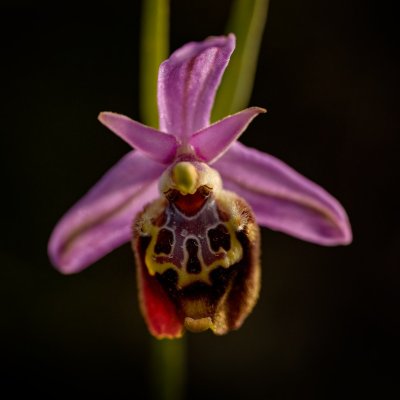
Tořič Omega (Ophrys omegaifera) Omega bee-orchid, Nectarios, Rhodos, Řecko
Ondřej Prosický | www.NaturePhoto.cz, Sony ILCE-1, Sony FE 100mm F2.8 Macro GM OSS, f/2.8, @1/640 s, ISO 400, pondělí 6. dubna 2026 9:18:32, 2026-4-2226.jpg


 Řecko
Řecko
Comments
(0 posts) Add comment