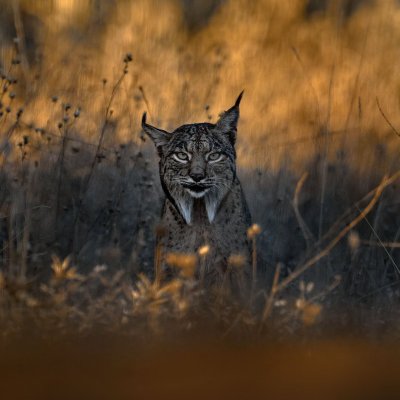
Iberian Lynx, Finally Back in the Mountains Too

The biggest positive of our latest trip to Spain was that we didn’t have many photos on our memory cards. There was no need to spend hours deleting images or agonising over which one was the best. Exactly as I wrote here in January after the previous trip, I was once again reminded of just how fragile the chances of encountering truly wild animals can be. How little it takes for us not to see even a single hair of an Iberian lynx. I think I must have been getting on my clients’ nerves by the end with my constant optimism, searching, refusing to give up, and making everyone keep looking through their binoculars.

Waiting in the Hide

Many photographers think that once they arrange a hide with friends on the other side of Europe, photographs of their dream species are practically guaranteed—and served up on a plate. Not at all. If there is no bait at the site, your chances are just as open-ended as if you had quietly climbed into a ditch and simply waited.

I think the photographers who joined me in the hides near Santa Cruz de Mudela could certainly tell you something about that. Encounters are rare. Usually there is just one per day, often brief, and frequently early in the morning or late in the evening. An Iberian lynx might simply walk past the hide in a matter of seconds without looking at the lens even once—so all you get to see is its tail.

And by now we also know that there can be very long days, from darkness to darkness, when this magnificent cat does not show up even once. Fortunately, that happened only after we had already got our first photographs the previous day.

That is nature, and there is no reason to be disappointed. Especially when you realise how precarious the situation of the “Iberians” was less than three decades ago. The species was pushed to the brink by habitat destruction, hunting, and the decline of its main prey—the European rabbit. Thanks to targeted conservation efforts, however, the lynx population has increased dramatically.

When I first went to photograph them in 2020, there were approximately 1,100 Iberian lynx living in the wild. I returned every year—they really are magnificent animals—and this December we photographed them there again. Their population may now have reached as many as 2,400 individuals, and their range has expanded significantly as well.

That is a genuine reason to celebrate. After all, in 2002, when the species was right on the brink of extinction, there were just 94 (!) Iberian lynx left in the wild.

Králík divoký (Oryctolagus cuniculus) European rabbit, Santa Cruz de Mudela, Andalusie, Španělsko
Ondřej Prosický | www.NaturePhoto.cz, Sony ILCE-1M2, Sony FE 300mm F2.8 GM OSS + 2X Teleconverter, 600.00 mm, f/5.6, @1/200 s, ISO 800, neděle 7. prosince 2025 11:59:29, 2025-12-4082.jpg
Rys iberský (Lynx pardinus) Iberian lynx, Santa Cruz de Mudela, Andalusie, Španělsko
Ondřej Prosický | www.NaturePhoto.cz, Sony ILCE-1, Sony FE 70-200mm F4 Macro G OSS II, 117.00 mm, f/4.0, @1/1250 s, ISO 400, neděle 7. prosince 2025 16:08:05, 2025-12-2233.jpg

On the Ridgecrest

After my unsuccessful attempt to find an Iberian lynx in the mountains of Sierra de Andújar in January—when low cloud and visibility of just a few metres made it impossible—I felt much more confident about our chances during the second part of our lynx trip. The weather was considerably better. If a lynx appeared on the rocks 1,500 metres away, I would be able to spot it. I have become quite familiar with them by now—I have a pretty good idea where they move, where and how they rest, and which places they prefer.

And that knowledge paid off at a spot where lynx are seen most frequently—and yet, in five years, I had never seen one there. This time, it was there. On a ridge where we had photographed Red Deer with magnificent antlers at sunset in previous years.

Unfortunately, the sighting was very brief. I barely had time to put down my binoculars and pick up my camera. I had exactly two seconds to get a photograph before the lynx disappeared behind the ridge.

I immediately alerted the other “lynx watchers” in the area. More eyes see more. We kept searching for it farther on, a little lower down the slope. At that moment, I was the only person on that famous lynx ridge who had seen the Iberian lynx that day—and I still believed that, even though the sun was due to set in an hour, it might give us another chance.

Straka obecná (Pica pica) Eurasian Magpie, Santa Cruz de Mudela, Andalusie, Španělsko
Ondřej Prosický | www.NaturePhoto.cz, Sony ILCE-1M2, Sony FE 300mm F2.8 GM OSS, 300.00 mm, f/4.5, @1/320 s, ISO 250, pondělí 8. prosince 2025 14:21:07, 2025-12-4449.jpg
Rys iberský (Lynx pardinus) Iberian lynx, PN Sierra de Andujar, Andalusie, Španělsko
Ondřej Prosický | www.NaturePhoto.cz, Sony ILCE-1M2, Sony FE 300mm F2.8 GM OSS, 300.00 mm, f/3.2, @1/20000 s, ISO 2000, úterý 9. prosince 2025 17:21:45, 2025-12-4649.jpg

In the Darkness

Can you photograph an animal you can no longer see after sunset?

In my opinion, this is a fundamental skill for successfully photographing truly wild animals that are active at dusk or before dawn—or animals hundreds of metres or even kilometres away. (Hint: some camera sensors can now see better than the human eye.)

The wandering Iberian lynx found its way back to us in the evening—and it turned out there were two of them: a female with her year-old cub (can you spot it in the photograph?). Unfortunately, by then the light for photography after sunset was… well, let’s be honest—it was almost completely dark.

I quickly took at least a documentary shot, then ran a quarter of a kilometre back to our nine-seat VW Caravelle. Over the next kilometre, I started picking up the clients so I could drive them to the lynxes. By then, their eyelids were getting heavy and they were beginning to look for a comfortable position to sleep.

Gravel was flying from the dirt road behind the minivan as we drove off, but we made it in time.

Next time, though, I’ll have to spend more time preparing my clients for how to photograph an animal with a two-second exposure at a moment when they can’t actually see it, and only some cameras can show them where it is. Even precise manual focusing turned out to be a huge challenge for the photographers.

In fact, I don’t have a really good photograph myself either. I was so focused on making sure that every client got at least one usable image of the sleepy lynxes that it became quite a battle.

This time, I had to put my own desire for a good photograph aside. The priority was to get the photographers to the lynxes quickly and teach them how to photograph in near darkness.

I have arranged the next joint trip to Andalusia to photograph Iberian lynx for 14–19 December 2026, and the first three participants have already signed up.

Related links

Articles about my encounters with the Iberian lynx: first time (2020), second (2021), third (2022), and fourth (January 2025)
Articles about wildlife photography
Iberian lynx photographs on Shutterstock
Photography workshops in 2026
Photography trips in 2026

Rys iberský (Lynx pardinus) Iberian lynx, Santa Cruz de Mudela, Andalusie, Španělsko
Ondřej Prosický | www.NaturePhoto.cz, Sony ILCE-1, Sony FE 70-200mm F4 Macro G OSS II, 112.00 mm, f/4.0, @1/1000 s, ISO 400, neděle 7. prosince 2025 16:08:27, 2025-12-2249.jpg

Rys iberský (Lynx pardinus) Iberian lynx, Sierra de Andújar, Andalusie, Španělsko
Ondřej Prosický | www.NaturePhoto.cz, Sony ILCE-1M2, Sony FE 300mm F2.8 GM OSS, 300.00 mm, f/4.5, @0.5 s, ISO 100, úterý 9. prosince 2025 19:08:15, 2025-12-4705.jpg
Bažant obecný (Phasianus colchicus) Ring-necked Pheasant, Santa Cruz de Mudela, Andalusie, Španělsko
Ondřej Prosický | www.NaturePhoto.cz, Sony ILCE-1M2, Sony FE 300mm F2.8 GM OSS, 300.00 mm, f/4.0, @1/500 s, ISO 500, neděle 7. prosince 2025 13:33:10, 2025-12-4139.jpg
Pohled na východ k Sierra de Sugura, Sierra de Andújar, Španělsko
Ondřej Prosický | www.NaturePhoto.cz, Sony ILCE-1, Sony FE 70-200mm F4 Macro G OSS II, 94.00 mm, f/8.0, @0.5 s, ISO 125, úterý 9. prosince 2025 8:01:37, 2025-12-2300.jpg
Rys iberský (Lynx pardinus) Iberian lynx, Santa Cruz de Mudela, Andalusie, Španělsko
Ondřej Prosický | www.NaturePhoto.cz, Sony ILCE-1M2, Sony FE 300mm F2.8 GM OSS + 2X Teleconverter, 600.00 mm, f/5.6, @1/800 s, ISO 1600, neděle 7. prosince 2025 17:48:36, 2025-12-4410.jpg
Rys iberský (Lynx pardinus) Iberian lynx, Santa Cruz de Mudela, Andalusie, Španělsko
Ondřej Prosický | www.NaturePhoto.cz, Sony ILCE-1, Sony FE 70-200mm F4 Macro G OSS II, 112.00 mm, f/4.0, @1/640 s, ISO 400, neděle 7. prosince 2025 16:08:34, 2025-12-2255.jpg
Rys iberský (Lynx pardinus) Iberian lynx, Santa Cruz de Mudela, Andalusie, Španělsko
Ondřej Prosický | www.NaturePhoto.cz, Sony ILCE-1M2, Sony FE 300mm F2.8 GM OSS, 300.00 mm, f/2.8, @1/3200 s, ISO 250, neděle 7. prosince 2025 17:12:35, 2025-12-4279.jpg
U kozorožců, zleva Pepa, Saša, Petr, David, Martin, Filip, Robert a Ondra.
El Torcal de Antequera, Andalusie, Španělsko, 11. prosince 2025
Photographer
Ondřej Prosický
Ondřej Prosický

focuses on wildlife photography. He wants to capture the behavior of animals in their natural surroundings. Photo workshops and expeditions focusing on nature have been organizing since 2006, publishing in the media and having more than four dozen author exhibitions.

Among his greatest achievements is participation in the finals of the prestigious Wildlife Photographer of the Year photography competition. He has been a member of the Association of Professional Photographers of the Czech Republic since 2009. In May 2011, the European Federation of Professional Photographers awarded Ondřej Prosické the QEP (Qualified European Photographer) title in the Wildlife Photography category, and in the same year he received the FEP Landscape Golden Camera award in Brussels. The most recent awards are the nominations and main prizes of the Czech Press Photo, Czech Nature Photo and the Festival de l'Oiseau et de la Nature in France.

Vloženo
03. 01. 2026 , categories: travels, europe
Share

Comments

(0 posts)
Add comment

Add comment