Courtship with a Little Fish
I came very close to witnessing Blakiston’s Fish Owls mating.
At first, only one of the owls flew down to the water to hunt. It ate the fish it caught and immediately went back for another. But on about the third or fourth return, it carried one of the fish away. I immediately thought, “Who on earth is it taking that to?”
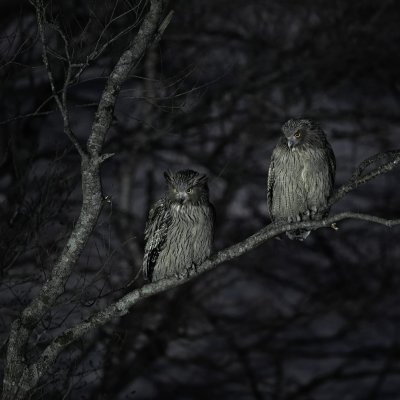
I strained to see through the darkness towards a distant, unlit tree and, sure enough, there were two owls sitting about a metre apart. I probably nearly had a heart attack and immediately started panicking about how on earth I was going to photograph them in that darkness.
Through the viewfinder, there was nothing but blackness, without even the slightest hint of a lighter edge. I quickly switched to Live View, set ISO 20,000, and my Canon EOS-1D X (it was 2015, for those who remember) could suddenly see better than I could. The owls appeared to move in the sea of digital noise, even though they were sitting perfectly still, but the important thing was that I could actually see them!
Even though I could make them out quite clearly on the camera’s screen, I was still getting a shutter speed of two seconds. But I took the shots anyway. There was no time for heroic further adjustments—the owls were actually passing the fish between them. It was an extraordinary moment that was simply impossible to photograph properly…
I had perhaps three seconds to locate the owls in the darkness at a distance of around 30 metres, focus manually and set the exposure. I had not expected this situation, and there was simply no way it could work out.
I kept thinking about what I could have done better, but even in hindsight I can’t think of a way to photograph such a scene without using a flash or some other light. (The “mess” in the original version of the article was there purely for fun.)
And it could have been even better—or worse, depending on how you look at it. According to the literature, a pair of Blakiston’s Fish Owls will usually mate about four days after exchanging fish. Fortunately, we already had to leave for our flight to Tokyo. I’m not sure I would have wanted to try photographing the darkness all over again. Back then, the camera’s display was literally the only way I could see this extraordinary moment.
I think photographic technology has improved quite a bit over the past ten years. So if we are lucky next February, I hope to give it another try with my Sony mirrorless cameras and perhaps improve on those photographs.
Into the Wilds of Hokkaido
You can join me in Hokkaido from 15–27 February 2027 for a journey into the Japanese winter wilderness. The main characters will be a Red-crowned Crane performing its spectacular dance, Steller’s Sea Eagle not only in flight, White-tailed Eagles in dramatic aerial battles, Blakiston’s Fish Owl as the world’s largest owl, Red Foxes posing in the snow, Sika Deer framed by the mountains of Shiretoko, Whooper Swans in icy hot springs—and an extraordinary winter landscape as the backdrop.
Related links
-
Articles about wildlife photography in Japan
-
Articles about nature photography
-
Photography workshops in 2026
-
Photography trips in 2026
Výr Blakistonův (Bubo blakistoni) Blakiston's fish owl, Shiretoko NP, Hokkaidó, Japonsko
Ondřej Prosický | www.NaturePhoto.cz, Canon EOS-1D X, Sony EF400mm f/2.8L IS II USM, 400.00 mm, f/4.0, @1/80 s, ISO 3200, sobota 7. února 2015 18:38:47, 2015-2-4344.jpg


 Japonsko
Komentáře ke článku
(7 příspěvků) Přidat komentář